The History of Oil Sands Development in Alberta: From Early Exploration to Modern Extraction

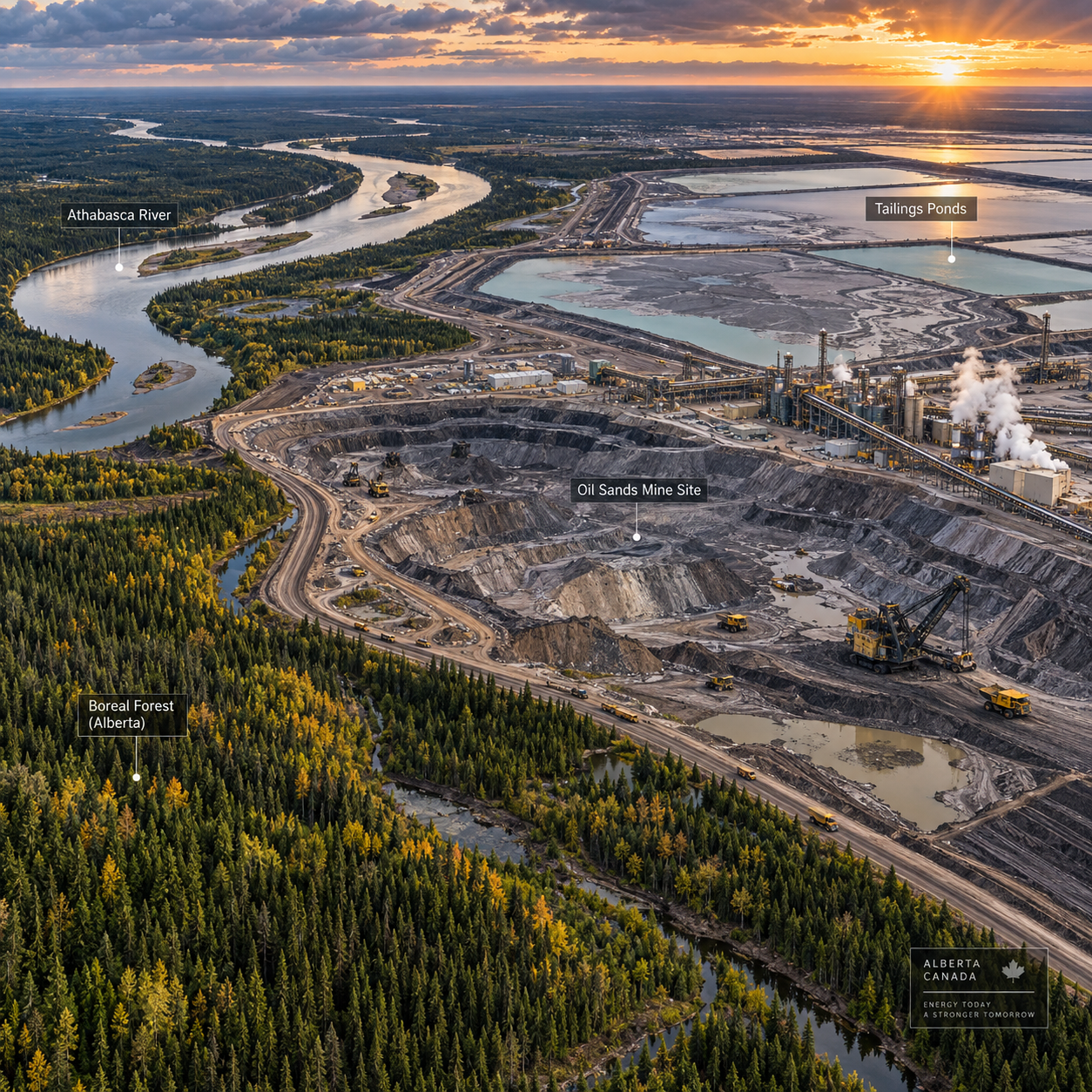
Alberta’s oil sands story is a history of changing technology and expanding industrial reach. Early observations of bitumen in the Athabasca region eventually led to surface mines and steam-based in-situ operations, bringing economic activity alongside lasting questions about land, water, climate, and the rights of Indigenous communities.
What are Alberta’s oil sands?
Alberta’s oil sands are deposits of sand, water, clay, and bitumen, a dense form of petroleum that does not flow readily at ordinary temperatures. The resource lies mainly in the Athabasca, Cold Lake, and Peace River regions, and companies recover it through surface mining or in-situ methods such as steam-assisted gravity drainage (SAGD).
The distinction between the methods is largely geological. Where deposits lie close enough to the surface, operators remove overburden and mine the oil sands. Deeper deposits cannot be excavated economically in the same way, so in-situ projects heat bitumen underground and pump it to the surface.
Both approaches require energy and infrastructure, but their footprints differ. Mining transforms large areas directly and produces oil sands tailings; in-situ operations avoid open pits but require well pads, roads, pipelines, and substantial steam generation. Neither method is impact-free, and local effects depend on project design, location, and operating practices.
Early observations and exploration
Long before industrial production, Indigenous peoples knew and used naturally occurring bitumen in the region. European fur traders and explorers later recorded the deposits, but it took decades of study to understand whether the material could be processed into a useful fuel at scale.
In the nineteenth century, explorers including John Franklin described bitumen deposits along the Athabasca River. In the early twentieth century, geologist and inventor Sidney Ells studied the resource and tested ways to separate bitumen from sand. His work helped establish the possibility of commercial use, though early processing remained difficult and costly.
Government research and small-scale experiments continued through the first half of the twentieth century. The central challenge was practical: bitumen had to be separated from sand, upgraded into a material suitable for transport or refining, and produced at a cost that could compete with conventional crude oil. Before reliable methods and infrastructure existed, the deposits remained a promising resource rather than a major industry.
This early period also set a pattern that would persist: technical feasibility did not settle questions about who would benefit, who would bear local costs, or how development should be assessed. Those questions grew more urgent as commercial plans took shape.
From experiments to commercial production
Commercial oil sands production began in 1967, when Great Canadian Oil Sands, later known as Suncor, opened a surface-mining and upgrading operation north of Fort McMurray. The project demonstrated that bitumen could be extracted and processed at industrial scale, although high costs and technical challenges constrained early growth.
Surface mining became the most visible form of oil sands development. Operators clear forest, remove overburden, excavate oil sands, and use hot water to separate bitumen from sand and clay. The bitumen then requires upgrading or blending before it can move through pipelines and be refined. Syncrude’s large mine and upgrading complex began production in 1978, adding capacity and reinforcing the region’s role in Canada’s petroleum sector.
Government support, oil prices, infrastructure investment, and engineering advances all influenced the pace of expansion. Growth was not steady: market downturns and project costs sometimes delayed investment, while favourable economic conditions encouraged new proposals. The resulting industrial footprint includes mines, processing facilities, roads, pipelines, and tailings ponds, alongside communities and ecosystems that depend on the same regional watersheds.
For a concise overview of the resource and its development, the Government of Canada’s oil sands information provides background on deposits and production. Historical milestones explain how the industry formed; they do not, by themselves, answer whether every expansion should proceed.
In-situ technology expands development
In-situ extraction made it possible to develop deeper oil sands deposits that surface mines cannot reach. Steam-assisted gravity drainage (SAGD), now a major method, injects steam through a horizontal well to heat bitumen, which drains to a second well and is pumped to the surface.
SAGD’s commercial growth gathered pace in the late twentieth century and accelerated in the 2000s. Earlier recovery methods included cyclic steam stimulation, which heats a reservoir, pauses while the bitumen warms, then pumps the loosened oil to the surface. SAGD uses paired horizontal wells to support continuous steam injection and production. Other in-situ approaches may be used where reservoir conditions favour them.
The shift changed where development could occur. Instead of concentrating activity around mineable deposits, companies could propose well pads across deeper formations. In-situ projects generally disturb less land directly than a large open-pit mine, but they still require clearing for pads and access, pipelines to move steam and bitumen, and energy to generate heat. Their land footprint can be spread over a much larger area.
The practical comparison is therefore not simply “mine versus no mine.” Mining creates concentrated, extensive surface disturbance and large tailings volumes; SAGD avoids excavating the deposit but brings ongoing steam demand and dispersed infrastructure. Assessing a project means looking at its full footprint, energy source, water management, and cumulative effects with other operations.
The environmental and community costs
Oil sands development affects land, water, and climate through different pathways, and the scale varies by project and location. Mining removes boreal forest and soil, while both mining and in-situ production require water, energy, roads, and pipelines; mining also generates large volumes of tailings.
Tailings are mixtures of water, fine clay, sand, residual bitumen, and process chemicals stored in engineered ponds. They require long-term management, and the ponds can pose risks to wildlife and surrounding waters if containment or monitoring fails. Regulators require monitoring and reclamation plans, but restoring a mined landscape to a functioning boreal ecosystem is a long process, and a certified reclaimed surface does not mean the original ecosystem has been fully recreated.
Water is withdrawn from the Athabasca River and other sources under regulatory limits, with amounts varying by operation and conditions. Much process water is recycled, but withdrawals, groundwater interactions, and the handling of contaminated process water remain important watershed concerns. Climate impacts arise from fuel burned to produce heat and power, as well as from upgrading where it occurs. The emissions intensity of individual projects differs, while total emissions also depend on how much oil is produced and used.
Indigenous communities have distinct histories, rights, territories, and views. Some have pursued jobs, business opportunities, agreements, or equity participation; others have raised concerns about water quality, food harvesting, health, cumulative impacts, and whether consultation gives them meaningful influence over decisions. These positions can coexist within and across communities. Respectful reporting should not treat Indigenous peoples as a single bloc or reduce constitutional rights to a stakeholder preference.
For project decisions, an environmental assessment can examine expected effects, alternatives, mitigation, and monitoring. Its value depends on the scope of the review, the quality of evidence, public access to information, and whether cumulative effects and community knowledge receive serious consideration.
Opposition, regulation, and the road ahead
Citizen opposition has shaped the oil sands debate through public submissions, legal challenges, community organizing, research, and campaigns focused on climate, water, land, and Indigenous rights. The debate continues because regulation and technology can reduce some risks, but they cannot erase the trade-offs of extracting and burning a carbon-intensive resource.
Public concern increased as operations expanded and the scale of tailings, water use, and greenhouse gas emissions became more prominent. Residents, environmental organizations, Indigenous-led groups, scientists, and workers have entered the discussion from different positions. Advocacy has helped bring local evidence and questions about cumulative effects into public hearings and policy debates, though influence varies by process and by the decision-makers involved.
Regulation has also changed over time. Provincial and federal authorities set requirements for project approval, emissions, water use, tailings management, and reclamation. Environmental assessment processes can identify risks and impose conditions, but critics argue that fragmented reviews may understate cumulative impacts across the broader region. Industry, in turn, points to employment, public revenue, energy supply, and investments in efficiency and emissions reduction. A balanced account should test these claims against project-specific evidence rather than treating either economic benefits or environmental harms as uniform.
For citizens weighing a new proposal, a useful four-part screen is place, pathway, people, and proof: Where will development occur? How could it affect land, water, and emissions? Which communities and rights-holders may be affected? What evidence, monitoring, and enforceable conditions support the decision? This framework does not predetermine the answer; it helps expose what an assessment may leave unresolved.
Alberta’s oil sands history is still being written. Decisions about new projects, existing facilities, reclamation, and energy transition will determine how long their impacts persist and who bears the costs. Public scrutiny matters most when it is specific: ask for transparent water and emissions data, meaningful Indigenous participation, credible tailings plans, and clear accountability after approval.